Sunday, February 13, 2005

distillation

I'm gonna miss my housemates.

It's official, I'm moving out of my place by the end of the month, to a single apartment on the other, cooler side of the station where hole-in-the-wall noodle shops vie for space with national chain izakaya bars and the exciting world of shopping takes place. My current neighborhood mostly involves men making houses for people to sleep in and people who stumble back from Tokyo at 11 at night to enjoy the wonderful world of sleeping. I haven't smelled much fish or curry wafting out of kitchen fans in my neighborhood so I figure most people go out to eat. The doorway of my old-old place in rural Saitama was placed right next to the kitchen exhaust of the place next door, giving me an olfactory preview of their nightly meal. They really liked grilled mackerel.

I'm not gonna drag my housemates into this blog any farther than to say that one of them has introduced me to the wonderful world of Japan's hot new liquor shochu. All of you stateside will have to tell me if this has seeped over to the US at all. (I doubt it.) Distilled from barley, rice, sweet potatoes or just about anything, shochu is going through a bit of a boom in Japan right , leaving fermented sake in the dust as a drink for smelly old men and weird foreigners who wanna experience "Japanese culture." Shochu bars which specialize in the finer brands from Kyushu and Chugoku in the muggy climes of South-Western Japan are popping up in Tokyo's chicest neighborhoods and as the watering holes of characters in TV dramas.

I'll admit, it took me a while to get used to the stuff. It's the first hard liquor I've ever developed a taste for; up till now beer and wine were the only types of alcohol that enlightened my mouth as well as my brain. The first time I had it was at an enkai (drinking party) during my first year here as an English teacher. The town's superintendant of schools, a remarkably dapper man who was pushing 60, unmarried, and read obsessively until the wee hours, subsisting on 3 to 4 hours of sleep a night, offered me a cup towards the end of one night of epic silliness. Japanese drinking parties seem designed to make you sick: you have to drink a few glasses of beer first, then everyone branches off into their own personal faves, with people sampling just about everything on the menu while Mitsuda from accounting does magic tricks. The superintedant is just pressing for you to try his favorite shochu, right after you've tried Matsuda's whiskey, Hashimoto's warm sake and Yamada's homemade plum liquor. I learned to just politely refuse and stick to the bottles of Japanese domestic beer.

The other times I had shochu it was cut with something else, like coke or tea. It also forms the alcoholic base for chu-hi, these canned shochu-hiballs flavored with lemon, plum or something else fruity and sweet. Hey man, when I wanna drink soda, I'll drink soda, what's up with a liquor that can't hold it's own?

But in these windy winter nights my housemate has convinced me of the joys of 4 parts cheap-but-decent shochu, cut with 6 parts hot water, fragrance rising up out of your mug; one cup a nightcap, two a shitty day at work and three a real party. As I sit here flying on number three (or four?), housemate at the computer next to me surfing god-knows-what on the internet, the mellow drink leaving me both relaxed and giddy, I'm comforted by one of shochu's legendary properties:

no hangover.
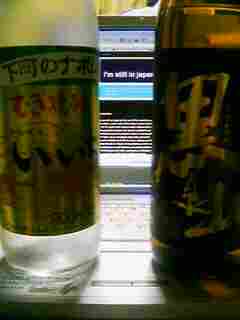

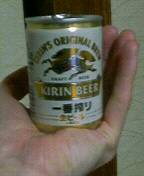
The closest thing I've got to a digital camera is this little thing on my cell phone which renders all photos in a pixellated digital haze.Posted by Hello

Thursday, February 10, 2005

21st century dating

When I was in college and gleefully chewing up Japanese literature, one of my favorite novels was Kagi (The Key) by Junichiro Tanizaki. Written in 1956, the story is a remarkable experimental work, taking the form of two diaries of a married couple detailing their sexual life and innermost thoughts. The chapters alternate between the diaries, and while they start out independent of each other, the couple and the reader gradually begin to realize they've been reading each other's secret diaries, and that what's being written is not so much the truth as another level of the power play in their relationship. It is a psychologically stunning book, twisting your head around every word to see if it is "true" or just written for the other person's benefit.

The other night after penning that last blog entry I ended up kicking around the internet, found some blogs where people wrote about their dating life. I poked around half interested, but my eyes shot wide open, I stood straight up and just went dumb when I found that in two completely independent websites two people were blogging about dating each other, writing as if the other person wasn't reading. The girl is part of some public blog thing where you write about your dating life, the guy just includes that stuff regularly in his blog. They both mention the fact that the other person is blogging the relationship, but they don't let on any reservations about this whatsoever. They even wrote when and where they slept with each other. But they still insist on blogging about each other under aliases. I mean, there's something to be said for people who anonymously blog their dating life, but they and their partners are usually anonymous, right? These two have their photos and contact info right next to the blow-by-blow of their dates!

My mind has really been reeling from this. Both these people seem relatively normal. Well, as normal as wealthy New York yuppies can be. The biggest complaint the guy has written in his blog (February 9th entry) is that the windows in his high rise apartment are way to big, and he's worried that the lawyers across the street think he's some kind of playboy because of all the beautiful women that are constantly coming and going. I hate it when that happens.

This totally raises all kinds of "The Key" type issues. For instance, when they go on a date are they both thinking about how to write about it, and worrying about what the other person is gonna write? Do they check the other's blog the next day? (Of course they do.) So then they're writing as much for the other person as for the general audience. I'm having a hard time actually believing these people are real, that they could actually be going through with this.

If Tanizaki hadn't written that book fifty years ago I would have said this is truly something completely new under the sun, but I suppose it's just the latest version of the eternal fascination with the love lives of the young and wealthy. But now we get to watch the machinations unfold day-by-day. I'd rather read a novel. With real people it's just... icky.

nippon vs. north korea

I set out two unspoken goals in this blog: 1) no writing about "that wacky stuff in Japan" and 2) no whining about my personal life. Well, I broke up #1 with my last post, so I might as well muck up #2 as best I can.

Tonight was the Japan vs. North Korea World Cup qualifier game, and I was invited out to a night of beer and soccer by an English teacher friend. While North Korea sometimes crops up onto the Op-Ed pages in the US, it is a daily issue in Japan. In addition to all their nukes, the North Korean government has taken dozens of Japanese hostages from the rural Sea of Japan coast, and the relatives of these hostages are a major political and morally righteous force in Japan, appearing almost daily on the local news, pressuring the government to further action against North Korea. There was a man outside my local station today with handdrawn cardboard signs and a petition that called for harder sanctions against North Korea in light of the hostage situation.

On the other hand, North and South Korea were colonized by Japan from 1910-1945: Japanese was made the official language and thousands of Koreans were forced into heavy labor projects, many in Japan. The Japanese postwar "economic miracle" was given a big boost when Japan was the main base and supplier of the US army during the Korean war. To this day many North Koreans who were forced into labor in Japan during the war are stranded here, denied Japanese citizenship, passports, or decent employment prospects.

It was in this context that Japan happened to be randomly selected to face off against North Korea in the first game of the World Cup qualifiers. The game was to be held in Japan, which subsequently chose my good old soccer crazy city of Urawa as the site of the match. Tickets sold out in 10 minutes.

In all fairness, the Japanese media was careful to distinguish between the North Korean government and the soccer team. The team was met with flowers and hordes of North Koreans fans who choose Japan and disenfranchisement over North Korea and dictatorship. But aside from all the expressions of good will, this was more than just another soccer game, these were gladiators in an arena.

There were nine or ten of us out tonight to see the game, about half English teachers living the fantasy life, half Japanese struggling in whatever work they can find and little ole me. The first bar we tried was packed full of fans, but the second had a line of tables just our size. The name of the place hung above the bar in neon, Modern Times: Restaurant and Bar. The staff reflected the modernity of the bar: the bartender had elaborately styled hair, wore a brand name button down shirt, and the only waiter in the place was dressed in a remarkably elaborate cowboy outfit.

I sat next to a Japanese guy about my age who was crazy about reggae and Japanese soccer. Across from me was a massage therapist/unwanted hair remover who was a soccer maniac and a cute and nervous librarian who was not. Japan scored one goal in the first few minutes. The reggae guy and I talked about MC's and clubs. North Korea scored a goal. The librarian and I talked about Japanese mystery writers. In the second half I actually watched the game. Japan scored in the last few minutes and the bar exploded into a round of toasting and drinking.

The soccer march ended with Japan winning 2-1. People trickled off until just five of us were left. The librarian had left me with a list of good authors and no phone number. The bill came out to more than we expected, and the five of us barely coughed it up. I suddenly realized there were two brand new couples and myself. We stumbled home in the bitter February air, brushing past the mahjong dens and massage parlors.

I waved goodbye to the massage therapist and her new boyfriend as I stepped onto the last train home. Sitting across from me was a man in his late 30's with the exact same type of Korean made backpack I used to own, tinted prescription glasses, an entirely waterproof outfit and a real utility belt with two pockets bulging off of his left hip. At one point he saved his seat with the backpack and ran to tell the conductor that someone had boarded without a ticket, who was subsequently booted out, no more trains left to catch. The guy picked his nose for the five minutes before my stop. After I got off I glanced back to see him and my old backpack slide away into the night, me alone on the platform and him strangely content, his index finger probing up his left nostril.

Monday, February 07, 2005

the nightcap of champions

I remember one summer before I'd ever come to Japan, before I even turned twenty-one, buying those oversized cans of Japanese beer you sometimes see in the important section of US liquor stores. My housemate and I just couldn't fathom what the hell was up with a can of beer that approached 2 liters. We poured the thing out into two glasses between the two of us and pondered the mystery. Now as an ex-pat with a few years under my belt I can confidently answer that the reason it's so big is because it's intended to be poured out among friends at a party.

I have always viewed the whole "look at all the wacky weird shit" in Japan mentality a little bit askew, because some people form these whole bullshit cultural theories off of the weird commercials on TV. Base, not superstructure people! Please. Where are your liberal arts educations anyway?

That being said, here's a picture of the 135 ml beer I'm drinking as I write this. Isn't it weird?


Posted by Hello

Why a beer so ridiculously small? I dunno, I figure the best part of beer is the first gulp. For the record, Kirin Ichiban Shibori is the best mass produced Japanese domestic, and just these few gulps have renewed my faith. =Those Japanese sure do like to make things small and convenient!=

That's the superstructure answer. The base answer is that my housemates went to a newly opened izakaya (Japanese style bar) in town, and they all got these micro-can beers as promotional take-home gifts. Funny, idn't it.

Sunday, February 06, 2005

rinji jinsei

Last night was the monthly Kuchi Kuchi DJ event in Omiya, a mix of domestic and imported DJ's spinning an array of genres whose distinctions I have a hard time understanding. One of the main organizers is an English teacher, and he pulled in a lot of white faces, mixing in with the local b-boys and hipsters. One of the people he pulled in was an old friend I hadn't seen since last summer, a Chinese-American English teacher who is just about as nuts about cooking as I am.

While catching up with him and going over our current situations, it began to dawn on me just how rare the two of us are. Everything about English teaching jobs discourages people from striking out on their own, or carving out a niche in Japanese society. Housing is provided for or arranged by most schools, your job itself is a liminal space, the projection of Japanese dreams of "America". Inflated English teacher salaries heighten the unreality. Even socially it's easy to simply get caught up in the narrow network of teachers and foreigner friendly venues. People dissapear forever, back to their home country and their "real life", and Japan was a two year layover, a few photo albums to put on the shelf, a second gap year between graduation and a real career.

Although I crawled my way out of the claustrophobic English teaching circuit and out into lower paying, more personally satisfying work, there's nothing inherently wrong with that world, I've met many wonderful people through it. What I take issue with is the transient mentality it fosters; an extended vacation, a few years of sightseeing in your own neighborhood.

I am currently searching for apartments in my area, the second time I've been in Japan when I've had to go through this process. I would say that close to 80-85% of the landlords I talk to refuse a foreign tenant straight out because they have had a bad experience in the past. The sense of unreality, the lack of consequences leads people to kinds of behavior they wouldn't pull back home; from unproperly seperated trash and strings of noisy parties to unpaid bills and structural damage to the house, all sins are unreal, without consequences. This is Japan, and I'll be on the other side of the world in two months. One bad example is enough for most landlords, who simply don't want to put up with the hassle.

There has also been a rash of military personell and English teachers who routinely scam the trains, simply hopping the gates on the way in and the way out, the staff too busy or intimidated to do anything. If you were a five foot tall middle aged train conductor with a pension would you confront five linebacker built GI's for hopping the gates?

While these are all fairly petty, they add up to a pretty bad image for foreigners, even the clean cut English teacher types. I pretty much see immigration to Japan as a necessity, and myself at the forefront of a massive shift in Japanese society. Japan will never be my home, it is still a redshift away from the US; I have no desire to erase my Americanness. But it is no longer strange, and in many ways no longer foreign. All the pontification on Japanese uniqueness and being treated as an outsider are a mental denial of the inevitable, a multicultural Japan. What I realized last night when catching up with my friend was that whether you are here for two years or twenty, during that time you are not just in Japan, you are Japan.

...
Postscript:
There was an interesting editorial in Tokyo's free English weekly Metropolis a few weeks ago that takes such a radically different stance from my own but argues it so well that I can't get it out of my mind. Worth a look.

kaze


Me and half the greater Tokyo area have nasty sore throats.


Wednesday, February 02, 2005

smarmy

There was some psychology experiment I read about last year where some researchers tested people's stress levels when shown pictures of George W., Clinton, Rush Limbaugh and other polarizing political figures. Not surprisingly, the subjects political affiliations determined whether they would get pissed off by just looking at a picture of George W. for a few seconds. I know that I certainly derive a pervserse satisfaction from looking at Bush pictures and feeling the rise in my gut that just reviles the guy. Putting his policies aside, I dislike the way he does the things, the smirk he wears, the childish little outbursts during the debates. ("Hey, my job is really hard. I go over all the data. That's a tough job.") Clinton and Reagan may have gutted US labor, waged a few wars here and there and mushroomed the US prisons to o.7% of the population, but I could at least sit down and have a beer and a civil discussion with those guys. I think I would have a hard time not just yelling and spitting like a feral cat if you put me near W.

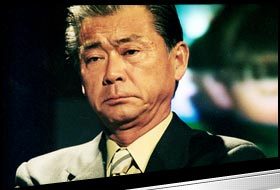
One of the pluses about being an ex-pat in Japan is you can just bliss out, let the cultural and language gap insulate you from many of the domestic problems here, and envision Japan to be as perfect or as imperfect as you want, going only on the trickle of information available in English and your daily experiences. While Japanese government remains a mystery to me, I've been learning a lot of cultural icons lately, and was surprised to find one I react to almost as strongly as Bush. Foreigners in Japan, here is the face of the enemy:


This smarmy face first drifted into my consciousness when I happened to stumble upon the Japanese version of "Who Wants to Be a Millionaire?" on TV (they give away a million yen, not quite as exciting as a million dollars), and wondered who that greasy host was. He just seemed to be another face in the sea of Japanese tarento, "talent", the ranks of the professionally famous who litter Japanese talk shows, and don't have do anything else than be famous to get on.

Soon that face was popping up everywhere in my life, like when I was browsing beers, and came upon this horriying little gremlin from Ginga Kogen, normally an excellent Nagano brewery:


This is Oyasumi biru, "Goodnight Beer", an unsettling little nightcap for the hard working Japanese man over 40. Seeing the guys face rankled me something fierce; I mean, have you ever seen a smile so disingenuous?

In anycase, my suspicions were correct. This man is Mino Monta, beloved spokesperson of Japan's graying generation, the postwar economic warriors who look out at the country they built with horror and revulsion. Over the New Years break I was eating one dinner in front of the TV, and stumbled upon a show hosted by Mino Monta that "exposed" the way South East Asian prostitutes were destroying Japanese downtowns. These poor women, often brought to Japan under false promises of entertainment work and frequently kept in abusive situations by yakuza employers, were vilified as "corrupting foreigners" who are destroying Japan's peace and innocence. Mino Monta took a kind of lurid morally superior satisfaction in condemning the whorehouses that lined main streets frequented by commuting school children. There was absolutely no mention made of the fact that all the employers and customers who actually created the situation are Japanese. Apparently this show is on every week, it's only theme the way foreigners are degrading Japanese society.

The other night I spotted another Mino Monta hosted show during dinner, and my lurid curiosity got the better of me. The title alone got me pissed off: Yo no naka de, kore wa yurusenai!, loosely translated, "This is Absolutely Unforgiveable!" Mino Monta and a carefully selected panel of older or conservatively young tarento talked about how Japan's youth are going to the pits. Their roaming reporter did man on the street interviews with older people, with his killer lead off question: "What pisses you off about young people today?" I found the reporter's aggressive tactics more unforgiveable than anything they exposed. At one point the guy bursts in, uninvited, to a booth in an internet cafe in Akihabara, where young computer geeks, paying by the hour, are typing away feverishly. One of them, showing remarkable restraint and tact, answered the questions that came at a furious pace. "How long have you been in here?" "Five hours... instant messaging online." "What, you don't like to talk to people!? Hey you [gesturing at a guy in the corner who is ignoring the camera and continues typing], what you don't like talking?" "Well, for some people it's easier to express themselves online, it's not as much pressure..." "How many friends do you have?", and so on and so on.

They also featured a "representative" panel of young people, ganguro kids and fashion victims, who only spoke in an impenetrable slang, which Mino Monta and the panel proceeded to attack straight out: "Why don't you talk normally! I can't understand what you're saying!" While most of them just stared back, jaws slack, one young man responded: "That's kind of the point." I know where he's coming from.


rrrrrrrrrrrrrr, I just hate this guy.

Monday, January 31, 2005

the other side of the pond

There is an advertisement that has been frequenting Tokyo trains recently. Despite its muted tones and simple layout it popped out at me amid all the ads for fashion magazines, cram schools, beer and laxatives. It is a photograph of a New York art studio, fashionable but not unrealistic, with two young women, a Caucasian and an Asian, working intensely on some pottery. They're both wearing no nonsense loose clothing, no trace of feminine appeal or obsequious fashionability about it. Although I can't be 100% sure, the photograph stands out from all the other hyper-real images in Tokyo advertising of air brushed and CG'd models hawking canned soup and skin products in that it seems to be a real situation, no touching up or even dramatic framing or angles. Overlaying the photo is the text, "I discovered the real me in New York City"; the internship linkup agency's contact info runs along the bottom edge.

Interestingly enough, there is an article and a photo essay in today's New York Times about the recent wave of young issei, first generation Japanese immigrants who flock to New York City as a place where they can freely pursue careers in the arts and find a better sense of themselves. The article is very well done, but didn't address one issue that I'm sure a lot of the issei are worried about: visas. I have met a string of young Japanese who have lived abroad for a significant period of time, but what with the US cracking down on foreign visas (particularly student visas), many of them were cut short and came back to a Japan they could barely relate to.

I used to work with one young Japanese chef who had gone to culinary school in Manhattan, had worked and interned at some of the best French and fusion restaurants in NYC, and was just getting settled in when her visa extension was denied and she flew back to Japan, her culinary credentials worth very little. Loyalty and seniority counts for a lot in Japan, and while moving around within the restaurant world and stacking up a list of internships is fairly common in the US, in Japan it's morecommon to get the Yoda treatment: intense and extensive training in a single kitchen. I met a young guy about my age the other night who works in a small kaiseki restaurant, Japan's haute cuisine. He has been working in the same three person kitchen for six years, and he told me that "I'm only just beginning to understand proper kaiseki."

Anyway, you could tell the girl was pure New York at one glance; she came to her interview on one of those mountain bikes you only see in the city, headphones snaking out from a pocket in her windbreaker, sporty sunglasses and her knife set tucked into a bike messenger bag. She didn't gel well with Japan at all; too gregarious, opinionated, and tough. One of the excellent details the NY Times article picks up on is how the Japanese femininity that squeezes voices higher loosens up in New York, with expat women speaking in deeper and more natural voices. There are a thousand little social cues like this that bind Japanese girls, from the prevalence of high heels and short skirts to a personality that avoids asserting itself too strongly. My friend was lucky enough to work for an American owned restaurant, but even then she was socially stranded, her quirks and aggressive personality just bowling over Japanese coworkers. She lasted a few months, but she's currently back in New York at a small fusion place in SoHo, working in three month visitor visa chunks, flying back to Japan every ninety days for a renewal.

Friday, January 28, 2005

nowhere, japan

Up til now I've basically relied on the loose metaphor that Saitama is Tokyo's New Jersey, and have said a few things about how it's very anonymity and lack of local distinguishing color makes it feel like one of the most thoroughly Japanese of all places I've been to.

Obviously every place in Japan is Japanese by definition, but it's a loose thing, this Japaneseness, more of a modern invention of mass communication than anything else. Just a hundred years ago the country was awash in impenetrable local dialects and regional customs. One of the classic examples is natto, fermented soybeans coated in this sticky goo, mixed with some sauce and mustard, usually eaten over rice. It also stinks to high heaven, like the smelliest cheese you could never actually bear to bring to your mouth. While people in Eastern Japan (including Tokyo) eat this stuff for breakfast, it's only just barely starting to be sold in the Kansai area (Kyoto, Osaka, Kobe).

In anycase, Saitama seemed distinct by its very lack of character. It is a prefecture of people who came from somewhere else, from cold little hamlets and one horse towns, coming to the big city, ending up in Saitama where the rents are lower and the groceries cheaper. In my two years here almost comes from some little town I've never heard of, or they have grandparents whose speech they can't understand. Uprooted from their hometowns and transplanted to the rough Kanto soil makes for a lot of lost souls. It's a pet theory of mine that the idea of a national Japanese identity only came into being with the massive move to the cities, and the advent of television.

At any rate, Saitama is concurrent in many people's minds to Japan at it's most bland and characterless. Saitama's nickname is "Dasaitama". Dasai is an adjective reserved for the likes of mullets, Pauly Shore movies and New Jersey. But with a prefectural population topping seven million, that is a lot of people to be calling lame, and something resembling local pride is starting to crop up.

It's remarkable how America exports both the image of "normal" modern life and the modern images of rebellion to other countries. Following this odd phenomenon, hip-hop is absolutely huge in urban Saitama. Although the bulk of hip-hop in Japan, like in the US is about cool cars, cool clothes and booty dancing honeys, the strain of hip-hop that pumps local pride and the empowerment from local hip-hop scenes has survived the trans-Pacific journey. It seems to cling fastest to those places blighted worst by urban development, the liminal gray zones of apartment blocks and corner factories. In my old neighborhood in Western Saitama the quiet train station was often overtaken by scores of hip-hop kids who brought in boom boxes and practiced breakdancing moves with their friends. They would use the broad windows as mirrors to check their moves. I never saw anything resembling a 40, and you better believe most of these kids had never even smelled a blunt.

Across the border in Tokyo prefecture (the distinction is pretty meaningless, the urban sprawl being pretty constant the whole way), hip-hop also thrives in the suburbs. Last year there was a major hit from a group called the Ota Crew, whose name is a pun on their hometown, Ota-ku, the largest ward in Tokyo. In my loose translation, the chorus of their hit went something like"In the alphabet it's O-T-A!/Biggest of the 23 wards in Tokyo ze!/In the alphabet it's O-T-A!/Feeling a'ight in the Keihin area today!"

But back to Saitama. The other night a local English teacher showed me his local watering hole, Riki. (Google translation software!) I'd walked by it a few times before, this rowdy Japanese style bar smack in the center of downtown Urawa, on a central corner in the middle of the pedestrian shopping area, with tables that spill out into the street even in January. There's a counter right on the corner with several baskets of yakitoris skewers, steaming in the January air, bought by hungry commuters grabbing a take-away snack for the walk home. It is emblazoned with posters that scream "We Are Reds!" in English, which I thought was pretty awesome, until I realized The Reds are the local soccer team. While the season is over now, this place is ground zero for fans who can't make it into the stadium during games. The Reds are the longest running soccer team in Japan, and for a long time they were the only major sports team in Saitama, lacking even a baseball team. As such they inspire fanatic loyalty in their fans, and my friend told me this place gets insane during games. The street will be jammed in every direction and they'll still be serving everyone, waitresses lugging pitchers of beer and ticking off orders on the little clipboard slips they leave with every customer.

The Reds took the championship this year, and while my memory of the story is fogged by all the beer on my brain when I heard it, Riki's was apparently the epicenter of the riot-party that followed. Urawa's downtown was brimming with whooping elated fans awash in alcohol and maniacal good spirits. Funny, but the only other time I've seen that type of thing here are at the local festivals, in the hometowns Saitama folk left behind.

Wednesday, January 26, 2005

keigo

Japanese is a notoriously difficult language.

Everyone says so.

If I had a nickel for every time someone here told me that "Japanese is difficult even for us Japanese", I would have a lot of nickels. Unfortunately my corner grocery doesn't take nickels.

Although Japanese is an orphan on the linguistic tree, huddled along with Korean as a grammatical anomaly, this is not what people mean when they say Japanese is difficult. One of the many complaints lodged at today's Japanese youth is that they can't speak proper keigo, the high wire act of formal speaking that gilds everyday spoken Japanese with a glut of formal terms. In it's roughest and most simple form, "What will you eat?" can be grunted out as "Nani ku?" but in keigo it could come out as "Go-shokuji wa nani o meshiagaru desho ka?" Keigo is not something spoken naturally, but requires study and effort. It's not an uncommon sight to see people studying books like "How to Use Business Keigo" on the train. Lacarated keigo is a television staple, with whole shows based around famous comedians put in delicate situations, forced to use proper language and failing miserably.

No matter how far along I progress in my own Japanese study, proper keigo remains a mystery, the very peak of Japanese study. Conversational Japanese is clipped and quick, whole sentences sometimes pared down to a single key word understood by context, but keigo gilds those phrases with loads of florid embellishments. This in and of it itself is not impossible, but most difficult for non-native Japanese speakers is not just learning formal language but using it appropriately. I was once out drinking with a friend who had studied quite a bit of Japanese in the States and could speak fairly well, but had only been in Japan for a few weeks. When we started talking to the group next to us, he completely broke the tone by standing up, bowing, and reciting verbatim the standard formal greeting that everyone learns on the first day of Japanese class. That's great when new business partners and textbook mainstays Tanaka-san and Smith-san meet for the first time, but not so applicable in a rowdy Japanese bar.

The danger for most of us who have been here too long is speaking too informally. As a token white guy you tend to get introduced to a lot of important people in rural areas; I've let some pretty rough sentences slip while making small talk with the local mayor, who, politician that he is, registers a mild shock, then proceeds to hug the foreigners and kiss the babies.

Keigo may just sound like a useless formality, but on another level it reflects a universal psychological reality. Although it's not laid out formally we have a host of these in English. My favorite is calling a company and starting off with "I was just wondering if..." Really? You were just sitting around idly wondering if there were any brake pads in stock, and once you find out, your curiosity can be put to rest? Japanese keigo is infamous for this kind of indirect language, but the only real distinction between it and formal English is that in Japanese they are laid out in neat little tables.

Monday, January 24, 2005

and now for something completely different..

Just found an excellent blog written in English by a young Iraqi woman, Baghdad Burning.

Sunday, January 23, 2005

seafood

It's time to come clean. I mean, it's been years since I engaged in anything like that. Hell, I washed myself clean with years of hardcore punk shows in Cleveland and avant-garde performances in Manhattan. I haven't smoked pot in... well, can't remember the last time. Anyway, I can now confidently admit that my name is Jamie, and I am a former Phish-head.

As a middle school student who couldn't dribble a basketball for his life, came close to tears when being hit in dodgeball and who liked music but found the choir geeks just too... creepy, finding the local jam band scene was a sign from heaven that there was more to life than cafeteria seating politics.

After going through a few years of drugs, rock and roll and absolutely no sex, I discovered jazz and exchanged dope and Phish for coffee and chord substitutions. Jam Band music just seems kind of emotionally facile to me, hard to listen to music that is so comfortably happy in a world that is so resolutely not. I finished out high school clean as a whistle and with a new vocabulary that included words like "cat", "four-to-the-floor", "II-V-I's", "C blues" and "dig." Ergo: "That Jim Hall is one serious cat, he was ripping through this four-to-the-floor C blues just dripping with II-V-I subsitutions. Dig?"

Anyway, although I don't exactly hide my past it's not exactly something you bring up all that often in conversation. The word Phish induces head bobbing agreement with the loyal and cringing disgust in just about everyone else. It conjures up images of legions of trust-a-farians (trust fund+rastafarian) kids from the suburbs slavishly following the band in gas guzzling SUV's. So imagine my surprise when I went to a DJ gathering last Saturday in the nearby city of Omiya and when I walk in the bar and it's laden with Phish memorabilia.

Japanese pop culture is on a notorious time lapse with the US. I've had clothing store clerks, excited to meet a real American, proudly announce "Bon Jovi Fan! Bon Jovi Fan! Me!" While hip-hop has lately been making it onto top ten lists, Japanese pop-star style is overwhelmingly 80's starlets and hair-metal rockers. Think back to middle school; remember Mr. Big? "I'm the One Who Wants to Be With You"? Mr. Big is hu-uge here. They've cut albums with Japanese folk-wank bands. Don't know why, but this has always been viewed as a negative. From Johnny Rotten screeching "think it's swell playing in Japan/when everybody knows Japan is a dishpan" in 1977 to the 2001 Tom Waits ballad about a washed up pop-star "Big in Japan", hitting it big in Japan is just not cool.

But back to Phish. The name of the place was the Good News Cafe, and I half expected a Christian Science Reading room taken over by some local party kids for the night, but no, it's a clothing store/bar run by two Japanese hippies. And I mean hippies. At four foot nothing with a freckled face and a pile of neatly tended dreadlocks on her face, Michiko looked like she'd been cut-and-pasted straight out of a fuzzy memory from those jam band shows. Her boyfriend Takeo is a round and clean cut guy who wears baseball caps backward and has a great smile. The DJ thing last Saturday is a whole 'nother story: techno kids, b-boys, Japanese hipsters and English teachers. Being the first Japanese Phish-heads I had ever met, I was curious as hell to hear their story.

The other night I had a translation job in Omiya, and when I'd finished I decided to go back the Good News Cafe, say hi and have a beer. There was one regular in, and I sat down and shared a few beers with her and Michiko. Like me, Michiko was pretty much adrift in the public school pecking order (which if anything is more intense here than in the US), and discovering Phish and music in general opened up a whole world, eventually leading to running this bar with her boyfriend. Phish only did one tour of Japan about two years ago, and according to Michiko every show was sold out and packed. By this time, the only other customer, in her 90 degree bangs and black turtleneck, was a little bored by our reminiscing, and as any Phishhead learns quick, if you want any friends who wash regularly, it's to keep that Phish obsession on the D-L. We talked about underground Japanese music instead.

For those of you out of the hippy loop, Phish broke up last year after over 20 years of touring, leaving a legion of blinkered suburbanites in their wake and me with a brief ping in my stomach. They were also just starting to hit it big in Japan, which for most bands is the beginning of the end. But hey, Mr. Big is doing just fine. They just can't talk to any of their fans.

mastaa

It was around this time last year when I first learned the word mastaa. I had just started dating a girl who lived about 50 minutes away by train. She had trekked out to the cafe I was working in, and I returned the favor by heading out to the place she part timed at. I wandered through the throng of bars, pachinko parlors and food stands that clustered around Omiya station until I found it: a yakitori joint, red lantern swinging proudly.

Two or three balding salarymen were scattered around the 10 or so stools at the bar, talking about the sumo tournament over beers and bottles of warmed sake. There was a lean guy roasting chicken over coals, and my girlfriend, hair back and in a blue apron, making conversation with the regulars. When she introduced her boss to me as mastaa (master) I nodded and asked his name. He looked uncomfortable. "Just call him mastaa," she whispered to me. I made conversation with the regulars, and it turned out we had a lot in common. I was born in New York and two of them had been to New York. My girlfriend poured beers when asked, but mostly just stood around and talked with the customers. Her job is known informally as kamban musume, "signboard girl", a young girl who is hired to brighten up an otherwise dreary little hole in the wall, to commisserate with the salarymen as they pour out their frustrations over a few drinks before heading home.

For all it's world dominating companies, small businesses still thrive in Japan. Entrepeneurs flock to every major train hub, grabbing up available space and scraping out a living selling weary Japanese commuters food, drink and love. In contrast to the massive formal structure of most Japanese organizations, these tiny bars and pubs are an extension of the personality of the owner, who is invariably charismatic and welcoming, and often well travelled. These small bar proprietors run everything from working class chouchin (red lantern pubs) to trendy upscale wine bars. It is precisely this individuality that makes these places attractive: to the working stiffs who frequent these places the mastaa is living the dream, free of the corporate structure, every day a party, free to display their lifelong obsession with Beatles memorabalia or South-East Asian artwork.

With seating rarely exceeding 10 stools around a bar, these places are for the most part the domain of customers who have been coming for years, and the ichigen kyaku-san, or customers who spot the sign and walk in off the street, are extremely rare. You're introduced into the fraternity (these places are overwhelmingly male) by friends or work colleagues. While I have been taken to dozens of these places by Japanese friends and colleagues, I tend to frequent the larger izakaya (Japanese style restaurant-bars) with their fleets of young staff echoing out WELCOME!'s and THANK YOU!'s in loud and rapid succession. But in all their noise, enthusiasm and good cheer, izakaya are mostly for groups going out with a flock of friends, not the kind of place you go by yourself for a warm drink on a cold night and a chat with the mastaa. But the idea of spending my nights with a bunch of exhausted salarymen cracking misogynistic jokes and kamban musume smiling through them doesn't exactly get me all excited.

So, finding the Good News Cafe was a bit of a revelation. In many ways it follows the same pattern as your average mastaa joint, with the theme (American hippy rock), the regular clientele and the charismatic mastaa, but it's also light years apart. The regulars are about 50-50 male-female, the place is run by a young couple, and the closest thing to a kamban musume is the Joni Mitchell poster on the wall. It's the first small bar I've walked into where they didn't ask what country I was from or where I learned Japanese within the first 10 minutes. We just talked about music, shared a few beers, and listened to records and the hum of the space heater that valiantly warmed the room against the January air.

Thursday, January 20, 2005

~shopping interlude~

Last week I wasn't speaking all that much. Not to say I didn't want to speak, just that I was having a lot of fun reading squiggles on a page and making them into sounds in my head, which didn't put much of a strain on my vocal chords. After a few days of English teaching, blabbing and being blabbed at for hours on end, my vocal chords were a bit strained, and I woke up this morning with a nasty sore throat.

The local groceries don't carry honey, so I walked down to the supermarket in the local department store, which didn't open until ten. I could see the staff scurrying around inside behind the glass doors setting up displays and straightening uniforms. The first row of doors had been opened to give those customers waiting outside access to seats in the entranceway. They were all taken up by fierce looking old women by the time I got there. (There is a brilliant word for fierce old battleaxe Japanese women: "oba-ttarion", which combines the Japanese word for older woman "obasan" with the English battalion. Pops into my head every time one of them shoves their way onto a crowded train draped with shopping bags.)

At precisely 10:00 the manager came and unlocked the door personally, then stood at attention and bowed to each individual customer as we walked in. I headed to the basement supermarket. There was a boy of about twenty standing with a plastic shopping basket, which he handed to me as I passed. I was the only customer in sight. The supermarket creeped me out. The entire staff, in uniform was standing at attention, one person at the end of each aisle. They would yell out Irrashaimase! ("Welcome honored customer!) as soon as I came with six feet of them. I wonder if they specify how close the customer should be before you yell.

I didn't see the order given, but after 5 minutes they were given permission to be at ease, and resumed shelving and scurrying, back to the normal frantic pace of a Japanese supermarket. Since older women are the only people who show up to a department store at opening time, guess all that bowing and scraping is for the oba-tarrion's, who I'm sure appreciate military discipline when they see it.

Wednesday, January 19, 2005

time to take a breather

Don't know how many of you are actually out there following this thing, but it's been occupying a much larger role in my life than I expected when I started it. Ever since I came to Japan I've been writing essays in my head, but never really had much of an outlet. It's now snowballing to the point where I find myself thinking over blog entries in my head whenever I take the train or have a spare moment. Which cries out for some kind of limits or structuring.

In my first post I invoked Alan Booth's name. Booth wrote just two books, both travel writing about his walks through rural Japan, and they are both masterpieces, and subsequently quoted to death by ex-pats living in Japan. Booth's famous last line to "The Roads to Sata": "You can't understand Japan" has been rehashed at too many goddamned teacher's seminars and Japan forums, but people invariably take his conclusion the wrong way, taking Japan as some mysterious unknowable entity, even to a fluent long-termer like Booth. Horse-shit. While he set out to understand Japan, and his life in it, his conclusion was that not just Japan, but life is unknowable.

What I love so dearly about Booth's two books is that he avoids the kind of meaningless generalizations about the country that plague so much writing about Japan. He just writes about his walks, and the people he meets ("I talked to an old woman who complimented my hyojungo [Standard Japanese] while picking a piece of flaking skin off her nose."), and the occasional smattering of cultural commentary. But he does not stray far from what is in front of his face.

Read simply as a walk through Japan, Booth's books are excellent, but I recently tackled haiku poet Basho's poetry travel journal "Narrow Road to the Deep North" and it was like being struck by lightning. Without advertising it or calling attention to the fact, Booth had taken most of his style and structure from the 17th century masterpiece. From the locations (rural northern Japan), to the method (a journey on foot, stopping at cheap local inns and temples), to the style (a series of isolated moments that do not possess any other meaning than their own uniqueness), Booth had taken a dead writing form and created a modern masterpiece.

Booth is alone in Japan writing in that he does not generalize, doesn't fetishize it's frantic modernity (hello William Gibson, cyber punks, anime geeks), he just lives it quietly, if somewhat inebriated. Probably the best example of the current state of writing in English about modern Japan is Japanzine. The overall tone of the contributors, mostly spoiled English teachers who are bitter about their jobs, is one of cynicism, condesencion, and a really dark sense of humor. To the foreign observer Japan can be hilarious (I'm laughing everyday), but the tone here is nasty and angry, toeing racism. At it's best Japanzine features the iconic Charisma Man comic, a spot on satire of scrawny white guys who come here to score chicks, over three years running, and at it's worst you get Ask Kazuhide, a fake advice column written by a made up Japanese old man who replies in Jap-talk, spewing a concentrated litany of the crap we hear all too often.

On one hand this is preferable to the hagiographic bullshit or xenophobic racism that both essentialize Japan as a country of geisha girls, suicidal samurai, mysterious martial arts and subtle indirection. But they both share the initial assumption that Japan is somehow essentially different from them, that even though they may have lived here for years, married into Japanese families, and speak the language, that there's something they're not getting, that there is a Japan to know. Japan itself is dry heaving through a cultural identity crisis. I don't pretend to understand Japan, but then again I don't pretend to understand America either.

I can just write about what I've seen and touched and tasted, and if you want to call it Japan, you can, but I wouldn't recommend it.

super kaimochi party

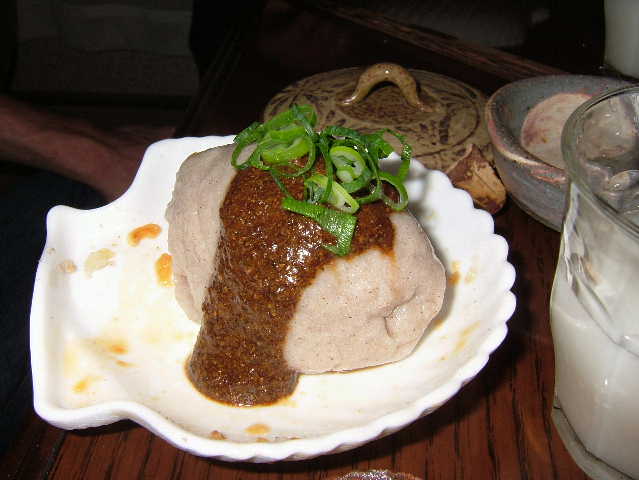
Last night I took the train out to my old digs in western Saitama to a dinner party at my former co-chef Yoshiko's house. I was asked to make kaimochi (sobagaki for all of you who grew up in the Tokyo area), which are basically dumplings of unbelievably soft soba (buckwheat) flour. I made these every day during my two month apprenticeship in Yamagata, but never actually got any pictures until last night, when a photographer friend snapped these on someone's digital. Yoshiko made a gorgeous tempura of local greens and we washed it all down with a bottle of nigori (cloudy unfiltered) sake. Also,please dig my haircut.

the making Posted by Hello

the tasting Posted by Hello

the food-ing
(the sweet brown sauce is made from ground egoma, the dried seeds of a plant closely related to shiso) Posted by Hello

the eating Posted by Hello

the enjoying
(left to right: Yokoyama-san, an organic farmer who sells produce to the cafe, Mai-chan, a new trainee at the cafe, and Eri-chan a new weekend staff member at the cafe)Posted by Hello

Tuesday, January 18, 2005

leaves in hot water (tea time)

I have made the Tokyo-New York direct flight more times than I or my wallet cares to count, and (at it's most reasonable), $500 is way too much to pay for two microwaved meals, a can of beer and three movies. Excluding the benefits of being moved from one side of the world to the other, a trans-Pacific flight is the most expensive triple-feature on the planet.

At best the movies tend to be faintly entertaining (Along Came Polly held up surprisingly well the three times I saw it), and at worst... you get The Tuxedo starring Jackie Chan and Jennifer Love Hewitt. I really enjoyed Jackie Chan's original Hong Kong and early US stuff, he had an old Hollywood style comedian's drive to be a purely likeable entertainer, not someone who laughs at their own bitter humor. But there was one line from the end of the movie that is absolutely seared into my brain. After all the action and fighting has finished and feuding spy partners Jackie and Jennifer have reconciled, he asks her out on a date:

"So you wanna get a cup of coffee sometime?"

"I'm sorry," she replies in her snootiest voice "I only drink organic green tea." Oh cool, I thought, they're gonna go out to tea.

But, speaking for the audience, everyman Jackie replies "Come on, just get a cup of coffee with me." She relents, they walk into sunset, credits roll. Congratulations committee that wrote The Tuxedo: American hegemony and ignorance in three short lines. Or did these Hollywood writers not know that green tea wasn't invented for yuppies but is consumed daily in the world's most populous country? (Hint: Jackie Chan is from this country.)

Here in Japan (not the world's most populous country, but one whose tea I know a bit more about) going out for coffee is just as common as it is in the States. In fact it's of a much higher quality. I am amused to no end that when you see the option of "American Coffee" in a restaurant it refers to their weakest (and most watery) brew. It's only for people who don't actually like coffee. Four dollar cups of joe are more common, but the coffee is amazing, and the added value is in your surroundings, a quiet, tastefully decorated nook of a coffeeshop.

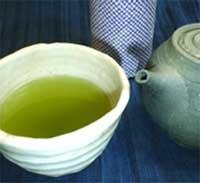
Unlike Taiwan and China, with their all night tea houses where people play cards and do business over pots of fragrant teas, Japanese green tea (o-cha) is overwhelmingly consumed in the home. One doesn't head out to get a finely roasted and blended cup of o-cha, it's an afternoon pick me up passed around the teacher's room at 3:00, it's a jar in the cupboard brought out when guests come to call, it's a souvenier brought back from an annual trip to Kyoto. Unlike Americans who guzzle watery coffee by the gallon, swilling from their liter-sized cups parked next to the PC or in the cup holder, green tea is still treated as a precious commodity.


Posted by Hello


By sheer coincidence, I have lived in all three of the most renowned tea regions in Japan (Kyoto, Shizuoka and Sayama, though the last is debatable), where good tea is as natural and everyday as tying your shoes. While my friends around the country had nothing but instant coffee to drink at work and the green tea was reserved for important guests, I was subjected to tastings of a whole spectrum of local blends. Each school employs at least one old local woman who is invariably full of smiles, speaks the coarse local dialect and whose job mostly consists of prepping the teacher's lunch and serving afternoon tea. One day at a school in Tenryu, Shizuoka I was given an exquisitely light tea that had a beautiful curling aftertaste. When I asked where it had come from, the tea lady looked out the window, squinted and stuck out her finger. "About, right over... there. Those tea bushes between the road and the river."

There is a mountain of information available on green tea's health benefits (prevents cancer, lowers blood sugar, rescues small children from burning buildings), and even more available on high end tea and tea ceremony, but I personally find all that stuff pompous and boring. I don't even like matcha, that powdered stuff used in tea ceremony; it's bitter and stays all chalky in the mouth after you swallow. I enjoy Shizuoka tea's raw, grassy aftertaste, Uji-tea's smooth mellow roundness and Sayama-tea's bold, direct flavors. I like a cup of green tea in the drowzy haze of 3:00 on a Tuesday afternoon.

But, in a bitter irony, most people here seem to choose a cup of instant coffee whitened with the disturbingly named powdered creamer "Creap" (short for Cream-powder?) over a simple cup of locally grown green tea steeped for barely half a minute in water just approaching boiling. I'm not really sure why, I think it's too easy to say "fascination with all things Western", because coffee has been here long enough that it can actually be written in kanji. I don't think it takes much guesswork though, fact is coffee is much better with cake than green tea, and who doesn't like cake? Even in Japan, nobody doesn't like Sara Lee.

Monday, January 17, 2005

~ a brief interlude ~

Whenever I get too cramped by this drafty little house I live in, I head down to the local Mister Donut. Mister Donut is a German chap who started the Mister Donut chain in Germany, and his photo is conveniently placed in every branch in Japan. The portrait of his geriatric face caught in the photo flash resembles nothing more than the kind of photo used at funerals. At any rate, they have a bottomless cup of coffee for 262 yen (app. $2.25 US), giving me hours to lose myself in Japanese essays on food, culture and history.

Having my first day off after three 9 hour days of straight English teaching with a 20 minute lunch break, I brought a book of essays by Haruki Murakami and a dictionary down to Mr. Donut and parked myself in a corner table by the window, watching the trains and cars go by.

As I was leisurely reviewing some new kanji I glanced out the window to a sight I had never seen before. A truck had pulled up just outside the coffee shop and parked close to the curb, and the driver in his faded blue company jumpsuit hopped out to unload the cargo. The cargo is what caught my attention though.

The back of the truck was a massive fish tank, cylindrical, but with round porthole windows that fish swam by. I craned my neck and saw that there was even a window into the cab so the fish could peer in at the driver. Talk about backseat drivers. "Fresh from nature to you: South Sea Live Fish Delivery" was written in big bold characters on the side. The driver opened a little hatch on the top and used a plastic collander to scoop eight or nine of the fish into a bucket. Once he had finished he locked the hatch and jogged upstairs to the restaurant. I sat, looking dumbfounded at the black outlines whisking around in their own habitat, smack in the middle of a busy street. They stared back at me in turn.

If there's anything more popular on Japanese TV than shows about cooking fish it's shows about catching them. Single massive tuna fetching hundreds of thousands of dollars in the Tsukiji fish market are sent packed in ice water (not frozen) from all over Japan, but this is the first time I'd seen live fish delivery. What a way to go as a fish. Instead of being inelegantly slaughtered on a dock in Hokkaido and having your fresh carcass stuffed in a styrofoam container, you get the tourist experience of a lifetime, a driving tour of Tokyo's high end entertainment districts, a chance to peer out in amazement at these hairless apes that have remade the above-sea world into a skewed wonderland of ferro-concrete and neon.

While the water looked a little green, and the fish a bit crowded, I can't imagine it's any worse than the conditions on a trans-pacific flight in economy class. I'm reminded of that immortal scene in The Great Muppet Caper where Kermit, Fozzy and Gonzo are packed in crates in the luggage compartment of a flight to England, and when Fozzy asks: "Hey Kermit, where's the steward call button? I'm getting hungry.", Kermit replies: "Umm, I don't think they serve food in ninth class."


Definitely one of my top 5 favorite movies ever. Posted by Hello

Sunday, January 16, 2005

eikaiwa

Well, I'm back. I basically knocked on fate's door and yelled at it to let me in after those last two blog posts on work, and was rewarded with five days in the spin cycle of Japanese work.

Ever since getting back to the Tokyo area I've pretty much confined myself to this rickety little house, notched next to an old couple who groan, play their TV loud, and bang on the walls when we are too loud for them. The second floor trembles in these nasty January winds and stray cats rowl in the night for food and love.

Staying inside gave me plenty of time to write my Japanese resume, create this blog, read movie reviews and pick my nose. I live with two Japanese guys who let me stay for free and pay for my groceries if I help out occasionally with translation or editing for their tour guide business, which didn't give me much of an incentive to get my ass on the street and get some gainful employment. I do, however, have a page online at findateacher.net that broadcasts my English teaching skills to the world, which leads to the topic of today's post: eikaiwa.

Eikaiwa is literally "English Conversation" but has also come to refer to the innumerable schools that teach English in Japan. After konnichiwa (hello), arigato (thank you), bakana gaijin (stupid foreigner), and chin-chin (bits and bobs, as in the male kind), eikaiwa is probably the first word a fresh young foreigner from one of the colonial countries will become familiar with. There are multi-storied English cram schools in Tokyo and family run classrooms on the second floor of the neighborhood grocery. Japan is obsessed with the idea of speaking English, and the phrase "Eigo wo shaberenai to..." (If you don't speak English then... [bad shit will go down]) is incredibly common; it's even used as the name of an NHK English education program.

English schools are a massive business in Japan, and the largest national chain, Nova, has over 640 branches around the country, all located in prime real estate: smack in front of the train station. In fact, Nova's slogan is ekimae-ryugaku, "do foreign exchange at the station", and they pump their foreign teachers for all they're worth, parading those smiling white and brown faces that promise a whole world of sexy yet platonic conversation. In my few years here I've met my share of Nova teachers, and while some enjoy the work, for the most part they hate their jobs. While the pay is alright (about $2500 US a month) they are treated pretty coarsely: shuttled from school to school, not allowed to teach the same group of students more than two or three times, working late hours (finishing 10pm standard), and generally just not given any respect or leverage at their workplace. Circumstances change from school to school, but there is a pretty basic pattern of paying wet-behind-the-ears college graduates a moderate fixed salary but giving them absolutely no control over their jobs. Bound to a textbook they are shoved into room after room of blinking Japanese students who've had four different teachers in the last two months, they do a little song a little dance and little English speaking, and are rotated to a new batch of students. All things being equal, I think mainly hate Nova because of their omnipresent, badly drawn, annoying-as-shit mascot the pink Nova rabbit.

Anyway, as the biggest eikaiwa around, Nova sets the standard for English schools here, and, with a few exceptions, until now I had only heard complaints about eikaiwa work. So I was a bit leery when I got a call last Monday from a local eikaiwa that had found my profile on findateacher.net and was interested in hiring me.

Just a 15 minute train ride away, the school is located conveniently enough, and I started feeling relaxed the minute I walked in the door. The school is a small operation run by two nice old Japanese women who had taught pre-school and kindergarten for years before opening their own eikaiwa. They had plenty of experience with foreign teachers, and were not the least bit surprised that I spoke the language well enough to conduct our interview entirely in Japanese. It was a surprise to be treated not as some touchy creature from another planet but as a professional with experience in the same field. One of their teachers had suddenly been hospitalized, and they needed an immediate replacement with teaching experience. We came to an agreement and I got myself a job.

Because of the emergency, I was rushed into three full days of teaching with no preperation, minimal briefing, and a smorgasbord of English students. Although about half my students were adults, this school specializes in the growing field of pre-school English education. Kind of like nipping a sprout to grow two stalks, the idea is to catch kids in their language developmental stage and barrage them with enough English so that it becomes a first language along with Japanese. It's a good indicator of how insane this country is about the idea of English that this has grown phenomenally popular in the past few years; so much so that Nova has been pushing the pre-school "Nova Kids" as hard as their adult classes.

While I have a slew of stories about my lessons this week, writing about them would take a few more pages with neither of us wants to slog through, so I'll just say that this week I handled a four hour pre-school class of five by myself (we drew snowmen, read story books and learned how to ask how to go to the bathroom), taught adult students phrases like "laymans terms" and "summer blockbuster", and tricked a particularly shy five year old into speaking English through puppets. From next week I'll be on the less punishing schedule of one full day a week and occasional classes, but I've had a few really wonderful conversations with the two women who run the place and I think we'll get along just fine. They also hate the Nova rabbit.

Wednesday, January 12, 2005

Work (paato 2)

In my last entry I tackled the mammoth topic of the work situation in modern Japan, a subject that some people devote their entire careers to studying, which I pithily tried to summarize in a blog post knocked off in around an hour. Clearly two blog posts should be sufficient to cover the primary obsession of a country of 120 million people. (I also revised yesterday's post adding a paragraph about women in the workforce and better conclusion for all of you who just can't get enough of this subject.)

Somebody (who failed to disclose their name) asked how "ganguro" kids fit into the work situation here. While I gave two educated guesses (convience stores and fashion boutiques), the question opens up the larger issue of the current state of youth and employment in Japan. The phrase parasaito shinguru (parasite single) refers to the increasing number of young folks who don't move away from home or get married, enjoying the free room and board and (according to the mass media stereotype) spend their work money on clothes, shopping and partying. Outside of the parasaito shinguru there are three major terms that have been bandied around a lot in the Japanese media that refer the irresponsibility of my generation.

The first, friita, coming from the English word "free", refers to young people who don't pursue a specific career path, instead flitting from part time job to part time job, and pursuing personal interests more than work. This may sound pretty unremarkable, but it is a brand new concept for Japan, where, since the rigid social structuring of the Tokugawa era (1603-1867), your job defines your identity. Japan's "economic miracle" was the product of a society that was soaked with memories of postwar devastation and put work ahead of all else in the hope of a better future. You sold your life to the company in long hours and total commitment, but the company would take care of you and your family through old age. The friita style of putting oneself before one's job smacks straight in the face of this system, and Japan has been tying itself in knots trying to figure out what's going on, with innumerable articles, panel discussions and economists weighing in on the economic and social damage friita are causing. Services hooking up applicants with short term work have been exploding. But as my pushing 30 cousin put it in a conversation we had about friita "Dude, sounds like me and most of my friends..."

Another trend that has wasted about as much ink and airtime as the friita issue is the emergence of "NEET" (pronounced neeto). In Japanese academia's love affair with clever English, NEET stands for No Education Employment Training, which basically sums up the NEET phenomenon. NEET sit one rung below friita on the troublesome youth scale, encompassing people who work only when they have to, disdaining higher education or any kind of commitment as a waste of time.

They are dynamoes of energy compared to the truly disturbing hiki-komori, which roughly translates as "the secluded." These are adults who for some reason or another never leave home, never find a job, and live off their parents. I have heard about this not just in the media but have several relatives of friends who are hiki-komori. I think the widespread existence of the problem points to a fundamental philosophical and spiritual malaise at the heart of the country.

The postwar era idea of being taken care of for life has lingered on, but the memories of widespread starvation and poverty during the Great War have faded, leaving no driving incentive to "rebuild Japan." Given Japan's draconian immigration laws, there are no major immigrant populations to shake the system up. With a steadily aging population and dropping birthrates, immigration is currently the only option, but not one that anyone has breached. A multicultural Japan is a subject that no one breaches, and seems almost impossible to imagine.

(Next entry more funny stories and less armchair philosophy. I promise.)

Tuesday, January 11, 2005

resume

It's been about a week since the New Years vacation ended, and Tokyo is groggily starting to kick itself back in gear, everyone walking around with the glow of the holidays and the grim knowledge that from here on out there's nothing to look forward to but spring and those iconic cherry blossoms.

Today was Seijin no hi, "Coming of Age Day", where everyone who turned 20 this year gussies themselves up in splashy kimonos and scarves and heads down to the local shrine. They are now officially adults, finally allowed to vote, smoke, swear, fornicate and abuse alcohol. Preferably all at the same time.

In a way it was my own personal "Coming of Age Day", albiet 5 years too late: I translated my resume into Japanese, signalling yet another step into the clutches of the Japanese social system. I did a rough translation myself, then asked my friend Nori to look it over with me. First question out of his mouth:

"Where's your birthday written?"

Ageism? Check.

"Do you have a passport size photo?"

Racism, hairism, not-good-looking-enoughism, check.

Me: "Well, why don't we just take it with your digital camera and print it out onto the resume?"
Nori: "Are you kidding? Color, high quality, those things are important. You need official passport size photos. And you should probably include a section on personal interests at the end here."
Me: ". . ."
Nori: "Oh, and you have to write resume (rirekisho) in big letters at the top there. Bigger. Ok."

Getting down to it, I suppose I shouldn't be surprised that resumes written in Japan would be so different from those in the US. I spent a good chunk of today finding resume writing advice online in English, and they contradicted Nori's Japanese resume model point for point: don't write resume at the top, nobody wants to hear "good with people", nobody cares about your stamp collection.

First off, what's up with divulging your birthdate, talking about your hobbies and attaching a photograph? Rhetorically, if not always in practice, the US ties itself in knots to avoid claims of racism, sexism and other forms of discriminatory hiring practices. As such, resumes, as projections of ourselves, become purely business related, pumping up the way you kicked ass at your library stacking job, increasing shelving rates by 60%. (Interestingly enough they also emphasized how you should leave out any "controversial" political connections. )Theoretically race, age, creed, gender, sexual orientation and favorite color should be irrelevant. I mean, hey, 60% increased shelving rate. We'll hire a Samoan grandmother who's queer as a 3 dollar bill and digs magenta if she can shelve books like that.

The state of employment in Japan is a bit different though. I think it is especially revealing to note that there are two words for "part time work" in Japanese. Arubaito or baito comes from the German arbiet and refers to any part time or non career oriented job for young people. Paato, coming from the English "part" is used to describe work for older women, usually married, who take on a job in addition to their husbands. More than discrimination, jobs are actually intended for specific genders and age groups. A common help wanted advertisement will list the ages suggested for the job, and many jobs for young women cut off at 30, the assumption being that a) who wants an elevator girl over 30? and b) you should be married and taken care of by then.

Last year there was a bestselling book that coined a new phrase, makeinu, "loser dogs", for single working women over 30. The author, a single working woman over 30, basically vetted the host of challenges unmarried women face, from the social stigma to the economic burden arising from both low paying jobs and a tax system hostile to single working people. The book (as I understand it) sought to dispel notions that women that old should be worried about marraige at all, and should embrace their independence and wear the makeinu label proudly and defiantly.

The stark reality of Japanese society is that not only do men receive better pay for the same work as women, but despite laws to the contrary, jobs are overwhelmingly defined by age and gender. But with the gradual decline of the Japanese economy in the last few years more and more married women are entering the workforce in service and factory jobs as paato to help make ends meet. Dad may still be the main breadwinner, but since she's been doing a few shifts a week down at the meat packing plant it's Mom who brings home the bacon.

Without saying this sense of "proper roles" extends to foreigners. While making a decent salary, Brazilians and Peruvians are generally confined to factory and occasional construction work, West Africans promoting bars and clubs, Thai and Phillipino women in the sex industry, Americans and Brits to English teaching jobs and modelling work, and Mongols to sumo wrestling. (For those of you who don't follow sumo, the current grand champion is Mongolian, as are many top ranked up-and-comers.) I am making up my resume both to score English teaching jobs to pay the bills, and restaurant jobs to keep my soul. But even finding restaurant work is tricky. Tokyo is a goldmine of foreigner friendly places, but they are the exception to the rule, most places simply would not hire me, not matter how good my Japanese was: a white face simply wouldn't fit the image.

In many ways I think the US operates on this level as well, with such intangibles as background and values mixing with race, age, gender and most importantly class in hiring practices. Instead we have developed a whole language of euphemisms to talk around these issues, whereas comfortably mono-cultural Japan has no qualms turning you down for any of the above reasons. Someone once referred an English teaching job tutoring a group of professors at a medical school who wanted to bone up on their conversational English for medical conferences, and was turned down flat "because we want a female teacher." Compared to us white folks Asian-Americans generally have a tough time getting English teaching jobs because they don't fit the blue eyed blond haired image.

Saturday, January 08, 2005

staying warm

When I first moved to Japan over two years ago on an English teaching contract, I was placed in the bucolic Tenryu city in Shizuoka prefecture. 15 miles from the pacific, snuggled at the base of the Southern Japanese alps, one of the largest rivers in Japan... and hot enough to fry an egg on the sidewalk. I arrived in August, when everyone was carrying around little towels to wipe off the sweat, and people smiled with a dumb pride when they told me Tenryu "is the hottest town in all of Japan!". Even though Tenryu is located in central Japan, the south is swept by cool breezes. All those picturesque Tenryu mountains create a bonchi , which is like a valley, but where air doesn't circulate in or out, it just sits and percolates. Ugh.

So imagine my surprise when winter came along and I was freezing my ass off. I've experienced four Ohio winters, and I don't remember a single one one being as rough as my winter in the hottest town in Japan. I would come home from school to a frigid apartment with a nice brisk breeze coming in through some crack in the window. Where the hell was that breeze in August?

Central heating is extremely rare in Japan. While fairly common in office buildings and department stores, it is rarely seen anywhere else. I have never been to a house or apartment with central heating, and even schools just heat classrooms and offices with space heaters, humidifying kettles of water bubbling on top. This makes for a great site in staff rooms with all the teachers huddled around a gas heater, backs hunched and hands outstretched like a camp of hobos.

The lack of central heating makes for a myriad of alternatives. Large metal gas stoves with flat tops for kettles that humidify the room, electric coil heaters, the occasional steam coil heated floor, 6 inch high R2D2 heaters for the bathroom, and those famously elaborate toilet seats. Americans laugh at the need for an electric toilet seat, but there's nothing funny about a freezing cold toilet in February. I'm a convert.

One of the greatest winter pleasures in Japan is the kotatsu. Although most modern kotatsu are just an electric heater placed under a table, I was lucky enough to experience my first real kotatsu last year during my two months in Japan's "snow country", Yamagata. Ingenious in it's design, a proper kotatsu is a square well in the tatami matting with warmed coals made from apple branches placed at the bottom. A wooden grating is placed above the coals, then a table with a blanket between the frame and the tabletop covers up the entire structure. The whole family will tuck themselves under the blanket during dinner the coals warming bodies from the toes up as they eat dinner and watch TV. With everyone sitting on the tatami, feet tucked into the deppression on the floor with no backrest, it's no big surprise to turn around and see grandma laid out flat, a faint snore shaking her drool onto the tatami.

I actually prefer no central heating, that stuff does an Operation Infinite Justice on my sinuses. Tokyo is a temperature schizophrenic city: you can be heaving in an sweltering lobby one moment then burst out into the blistering January wind the next. It is a bit alarming however when you're huddled under the kotatsu in your living room and your breath is curling into flowery white patterns. As the parents of an English teacher friend of mine put it to her: "We were worried about you at first, but hey, it's just like you took a year off to go camping!"

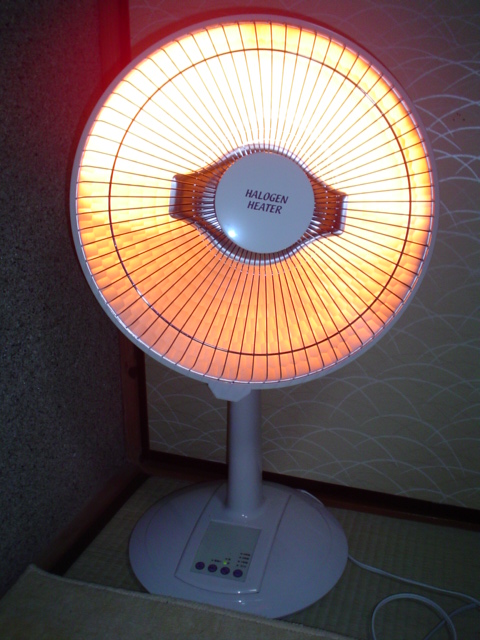
room heater


This isn't actually a fan, just my plutonium powered room heater set on low. Putting it on high causes temporary loss of vision.Posted by Hello

Wednesday, January 05, 2005

solid gold nuggets

I recently stumbled upon this absolutely wonderful blog written in excellent English by a woman in Kochi, Japan. She lovingly and extensively details her daily cooking, which is an incredible sampling of contemporary Japanese cooking.

Have been enjoying the essays on edge.org. Some of the worlds biggest names in science and philosphy write short essays on a slew of topics, and in the process provide an amazing overview of the current frontiers of contemporary knowledge.

My friend Tarika sent me this link to this guy who draws cartoon skeletons. Yeah. Cartoon skeletons.

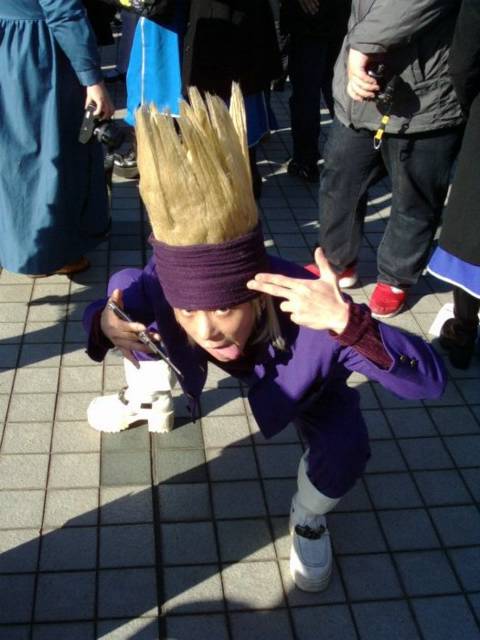
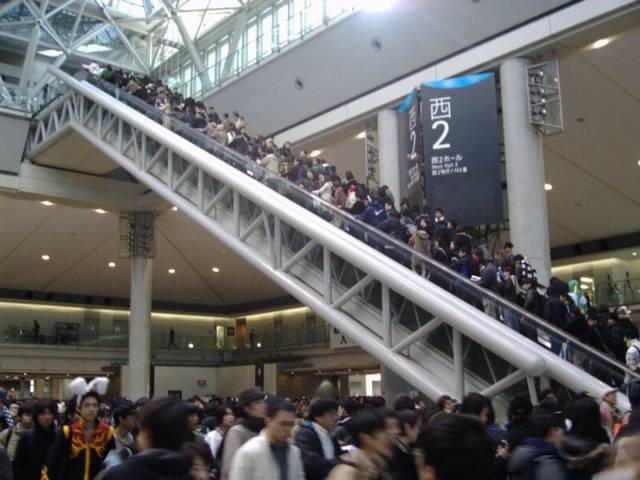
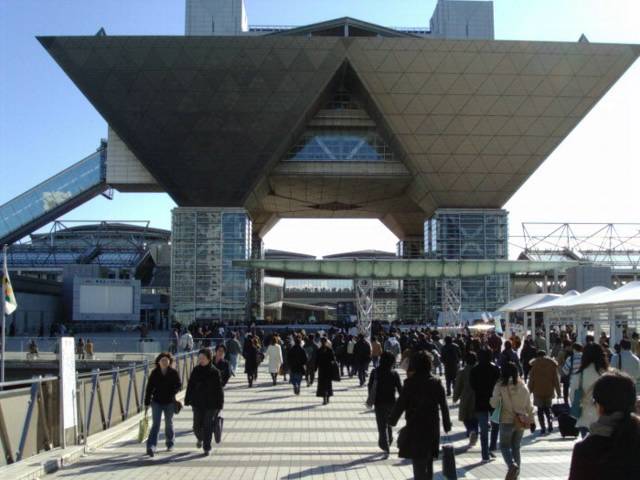
Below is a short piece on a massive underground comics convention I went to last week. My case for my not being a nerd is looking bleaker and bleaker.

Nerd Metropolis

Last December 30th I had the pleasure of attending the bi-annual Comi-ke (Comic Market) underground comics convention at Tokyo Big Site, which looks like My housemate Nori went to promote his Akihabara tours, and admission was free, so I decided to tag along and see what it was all about.

Nori certainly knows his market. I noticed several coach buses parked in front of the convention center circling round the clock to Akihabara. We arrived around 10 AM, but already the flow out of convention center seemed as heavy as that going in. Nori told me that these were the people who had camped out in the snow the night before to get the first crack at especially rare and valuable comics. They were heading straight to Akihabara to sell them at around 100% profit to stores that specialize in underground comics. All this and we hadn't even walked in yet.

Japanese Dojinshi (literally "peer publications") are a massive subculture in Japan. The definition is somewhat fuzzy, having started with amateurs who made simple comics and photocopied extras for their friends, subsequently exploding into any kind of small run comic that is printed and distributed by the artist and not one of the major comics publishers. How big of a subculture are dojinshi? Nori told me that half a million people attend this bi-annual two day convention. That is a lot of nerds.

Nerds being what they will, there were costumes. Really cool costumes. People in and into costumes congregated on an outdoor deck area. Guys with outsize digital cameras sporting lenses whose cost could feed a small African nation for a month vastly outnumbered fans in costumes. Guys in full on fatigues compared makeup with teenage girls in pink wigs and skintight action suits. Cartoon pigs bummed lights from Astro Boys. There was an entire etiquette of photo taking which everyone protected scrupilously; you needed verbal consent before any photos. (Which is why there are no smoking cartoon pigs posted below). Not surprisingly the more skin shown in a girl's costume the more photographers lining up to ask for her picture. Some people were ridiculously elaborate, the two figures in red pictured below were part of a 7 person coordinated squad, where one Japanese guy had even daubed his face and ears a rich chocolate brown in order to better approximate the black guy in the group. Whoa.

But about the comics. A few years ago I attended the Underground Publishing Conference (UPC) in Bowling Green Ohio, a fairly modest coference of underground comics artists and zines of all kinds, with a heavy anarchist DIY presence. There were about 800 people in attendance and it has since fizzled away. That was my last conference. Comike had about 35,000 seperate dojinshi groups that publish their own comics. For the unitiated the sheer volume was just overwhelming, I didn't know where to begin.

While UPC zines emphasized cheap and easy formats, most as simple as folded and stapled photocopies that flaunt their DIY aesthetic, the quality of your average Dojinshi at Comike was incredibly high. Printing in several colors on high quality paper and neatly bound was the standard. Japan is flush in small neighborhood printing shops that do printing for local businesses, and small runs of dojinshi can be published fairly easily.

While the content ranged from sci-fi stories to romance comics for little girls, by far the most noticable was the adult themed stuff. Dojinshi exist in a kind of legal gray area, and aren't subject to the government restrictions and regulations on mass produced stuff, which means the porn market is huge. It was more than a little unnerving to see female dojinshi artists proudly displaying their graphically detailed S&M comics with overtones of rape. But in general the atmosphere in the adult section was congenial and talkative, and outside of the occasional customer who had his scarf wrapped over his face and his cap pulled low, I didn't sense and furtiveness or shame. While the majority of artists were men, I was more than a bit surprised to note that probably 10-20% of them were women. For non-adult themed comics I'd say it was closer to 30 or 40%.

Since they averaged at around $10 a copy I didn't end up buying any comics, and when he ran out of business cards Nori and strolled down to the train station. Which turned out to be jammed with people leaving the convention. There was a 15 minute wait just to enter the station. I suppose it shouldn't have surprised me, but as we shambled along in the sea of nerds I picked out dialects from all over the country. There were even a few other white guys in the crowd, some with matching nerd girlfriends, others sullen islands unto themselves, bundles of carefully wrapped comics under both arms.


Costume deck against a Tokyo skyline. Posted by Hello

That's not really his hair. Posted by Hello

I have no idea what character this girl is supposed to be. Posted by Hello

Uncountable Nerds. Note lower left bunny ears. Posted by Hello

Tokyo Big Site Posted by Hello

Saturday, January 01, 2005

predestination

Well, happy new year, akemashite omedeto, welcome to the year of the Rooster. If you turn 12, 24, or 144 this year you are officially a rooster.
Which means that you "are a bit eccentric and often have rather difficult relationships with others." Which pretty much describes all the 12 year olds I know. But since these things can't be all negative you are also a "deep thinker, capable and talented." The web site I got these from doesn't specify the talents. Bronco busters? Amateur magicians?

I myself am a ram (sheep if you wanna be rude about it). People born in the year of the... ram, are, ahem "elegant and highly accomplished in the arts", and in addition "Ram people never have to worry about having the best in life for their abilities make money for them, and they are able to enjoy the creature comforts that they like." Hey, I just copied it off the web site. I'm afraid any of you thinking of having kids missed your chance in 2003 and will just have to wait til 2015. Every last kid born this year is growing up to be an antisocial goth who draws unbelievably detailed fantasy art.

Although all the barnyard imagery is all, like, cool and Asian, I haven't met a Japanese person yet who actually knows this animistic personality stuff. The Western Zodiac never really caught on here either; I suppose all the moons, cusps, scales and scorpions were a bit confusing. No, the official method of determining people's personality before you know them is... blood type.

This is something you catch onto fast as a newcomer to Japan, because the first question after name and birthplace is invariably "what's your bloodtype?". None of my Japanese textbooks included this in the greetings section. I didn't know the answer for a while, but dug out my American Red Cross blood donor card to find I am AB positive. Forget universal receiver, this is the blood type of geniuses baby.

I'm not exactly sure how the whole blood type theory got started, but I have to say that from sheer exposure to this I have started to give it a little credence. The basic outline is: "A's are neat freaks and sticklers for the rules, B's are relaxed, artistic types who will passionately work on one thing while forgetting to wash their socks, AB's are brooding geniuses who go their own way but always finish what they start, and O's are natural born leaders, who always keep the broad picture in mind. There is an ocean of pseudo-scientific evidence to support this. For example, it's common knowledge in Japan that the majority of Japanese are type A (the neat-freak rule-sticklers) and that the majority of Americans are type O (the American empire, it's in the blood man).

I once saw this amazing special on television that tested the blood type theory with a battery of pseudo-science. My favorite test was when the show divided a series of 1st graders into blood type groups and gave them an assignment: carry a bouquet of flowers to a teacher through a downtown shopping area. They placed three distractions along the way: free cotton candy, a busker with a dog doing tricks, and a guy in an anime character suit giving away free balloons. One by one the kids were launched onto the course, with reactions corresponding exactly to blood types. All the A's wavered indecisively before each distraction but pressed on. None of the B's ever reached the goal, most wandering off the course. The O's tried to get the best of both worlds, enjoying the free stuff but reaching the goal, albeit a little late. My fellow AB's kicked ass, not even glancing at the distractions, all heading straight to the goal.

Although lately I've been going through a rough patch, earlier this year I was predicting blood types at about 75% accuracy. Basically whether I believe in it or not is moot; this is the greatest small talk topic ever. No wonder the weather has been so freaky lately, it's just trying to get popular again.